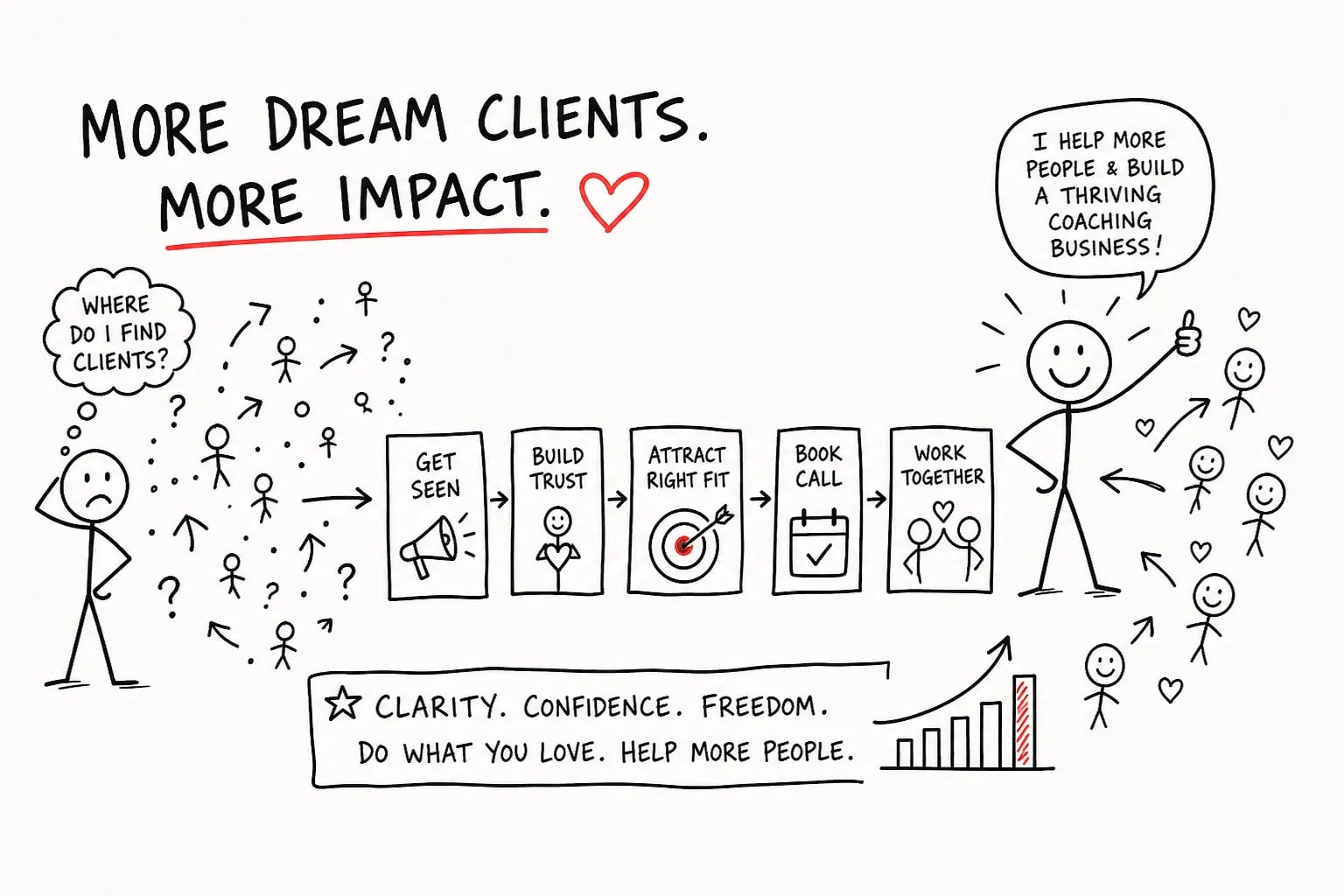
Many coaches spend their weeks posting content, sending DMs, and hoping the right person stumbles across their offer. Some get a few discovery calls. Most don’t get enough. The frustrating part isn’t a lack of effort. The effort just isn’t organized into a system. Client acquisition for coaches isn’t a random set of tactics, it’s a three-stage journey: attract, belief-shift, and convert. When all three stages work together, cold strangers become booked discovery calls without you chasing anyone. When any one stage is missing, the whole pipeline leaks.
This guide covers every asset and sequence that belongs in each stage, along with channel data to help you set realistic expectations. It also includes a 30-day implementation roadmap so you know exactly what to build first. The framework here is the same one that powers Client Acquisition Engine™ (Funnel In A Box), a system built specifically around this three-stage journey for coaches and consultants. Whether you build it yourself or use a system that builds it for you, the structure is the same.
Why most coaches’ client acquisition keeps stalling
The gap usually isn’t at the top or bottom of the funnel. It’s in the middle. Most coaches are comfortable creating attract content and can figure out a booking page. What they skip entirely is the belief-shift stage: the structured sequence of content that moves a cold lead from “who is this person?” to “I need to talk to them.” Without that middle layer, conversion rates on discovery calls stay low and every sales conversation feels like starting from scratch.
The channel data makes this concrete. Referrals convert to clients at 55 to 75 percent because they arrive with trust already built. Cold paid social traffic converts at 1 to 5 percent. The difference isn’t the offer, it’s the warm-up. A well-built belief-shift sequence recreates that warmth so prospects who find you through an ad or an organic post arrive at your booking page feeling the way a referral does: already convinced, already trusting, ready to talk details rather than debate the decision.
What “ready to buy before the call” actually means
Before a prospect books a discovery call, they’re silently asking three questions: “Can I trust this coach?”, “Will this actually work for me?”, and “Is this worth my time?” If your funnel doesn’t answer those questions before the call, you’ll spend the first 20 minutes of every conversation doing sales work instead of coaching work. The belief-shift stage exists to answer those questions through content, proof, and sequenced nurture, so the call itself becomes a formality rather than a pitch.
Client Acquisition for Coaches, Stage 1: Attracting Cold Traffic That’s Worth Your Time
Not all acquisition channels are equal. Spending your budget on paid ads before your funnel is proven is one of the most frequently cited mistakes in coaching marketing, and for good reason, it burns cash before you know what converts. The channel hierarchy by conversion rate in 2026 is clear: referrals (55 to 75 percent), strategic partnerships (12 to 25 percent), organic content (3 to 12 percent), and paid social (1 to 5 percent). Referrals and organic content compound over time. Paid ads scale efficiently only after your funnel is tested and converting.
Before you spend anything on ads, set up your referral ask. A dual-sided structure works well: the person who refers gets a free session or credit, and the referred prospect gets a discount on their first touchpoint. This kind of structured referral program can substantially shift your channel mix, one health coaching business reportedly increased referrals from 15 percent to 45 percent of new clients in six months using this approach, while reducing ad spend significantly. That’s a low-cost system with a measurable return.
If you do run paid traffic, know your CAC benchmarks by niche before you spend. Life coaching via paid social typically runs $150 to $400 per client. Business coaching runs $200 to $500. Health coaching runs $100 to $300. A healthy 3:1 LTV-to-CAC ratio means a $3,000 offer should stay under $1,000 per acquisition to remain sustainable. The attract content formats that belong at this stage include Facebook and Instagram ads, Reels, scroll-stopping hooks, and authority posts. These are awareness assets with one job: earn the click or the follow.
Stage 2: The Belief-Shift Content That Turns Cold Leads into Warm Prospects
This is the stage most coaching guides skip, and it’s why so many coaching pipelines leak. Awareness content gets attention. Belief-shift content changes minds. A cold lead who opts into your list doesn’t trust you yet. They need to see your origin story, watch a quick-win lesson, read a case study, and have their most common objection addressed before they’re ready to click a booking link. A structured email nurture sequence is what delivers that progression.
Industry data from sales and email marketing research (including studies cited by HubSpot and Mailchimp) consistently shows that the majority of conversions happen after multiple follow-up touches, often the second or third. A five-piece email sequence is the practical minimum for lead generation for coaches: an origin story email, a quick-win content piece, a client case study, an objection-handler email, and a myth-busting piece that challenges a false belief your audience holds about their problem or your category. Together, these replace skepticism with conviction before the prospect ever sees a booking page.
How long the nurture window should last
For warm traffic, organic followers and referrals, a 5 to 7 day nurture window before presenting a booking CTA is usually enough. For cold paid traffic, extend to 10 to 14 days and watch for behavioral signals: a link click, an email reply, or consistent engagement with carousel posts. Those signals indicate the prospect has crossed from curious to considering, and that’s the right moment to introduce the conversion offer. Presenting the booking link too early, before those signals appear, is one of the clearest reasons coaches see low booking rates from their email lists.
Stage 3: The Conversion Assets That Fill Your Discovery Call Calendar
Once a prospect has moved through the belief-shift stage, two well-matched assets close the gap between warm interest and a booked call: a VSL paired with a landing page, supported by a post-opt-in follow-up sequence. For a high-ticket coaching offer, the VSL should run 10 to 12 minutes and cover: hook and problem callout, why current attempts fail, your mechanism or framework, one or two proof points, objection handling, and a clear CTA to the booking page. The goal isn’t to close the sale in the video. It’s to make clicking “book a call” feel like the obvious next step.
Your landing page needs to match the promise of whatever brought the prospect there, the ad headline, the email CTA, or the VSL outro. A mismatched landing page drops conversion immediately. The page itself should lead with a benefit-driven headline, support it with social proof, and present a single CTA. After booking, a confirmation sequence keeps the prospect warm and reduces no-shows. Send a confirmation email to lock in the appointment, a pre-call primer that sets context and builds anticipation, then a reminder 24 hours before the call.
On the discovery call itself, lead with diagnosis, not pitch. Open with “What’s the main result you want, and what’s been blocking it?” A quick transition here helps: before jumping into questions, let them know you’d like to understand their situation fully before discussing anything else. Then move to pain-and-cost questions: “What does staying stuck cost you over the next 90 days?” Introduce proof only after you understand their situation, then close with a low-friction ask: “Would it be useful if I walked you through exactly how I’d approach this?” Coaches who pitch first create resistance. Coaches who diagnose first create connection, and connection closes calls.
Why Coaches Are Moving Away from Fragmented Tool Stacks
Many coaches assembling a client pipeline today are running separate tools for CRM, funnels, booking, and email, platforms like HubSpot, GoHighLevel, Kajabi, and Paperbell, each handling one piece of the puzzle. Based on published pricing for tools in this category, combined costs can easily reach $300 to $600 per month before accounting for any labor. Beyond cost, the deeper problem is consistency: when your ads, landing page, and emails are created at different times with different priorities, the belief-shift work you spent weeks building can unravel fast. Your prospect experiences a disjointed journey instead of a unified one.
Client Acquisition Engine™ (Funnel In A Box) is designed to address exactly this problem. A coach describes their offer and audience, and the platform builds out attract ads, Reels scripts, email nurture sequences, a VSL, landing page, booking page, and closing scripts, all aligned around a single strategy so every asset reinforces the same belief journey. The built-in CRM, calendar, and analytics are designed to replace the multi-tool stack entirely. The core differentiator is the belief-shift framework baked into the system: every asset is sequenced around the psychological journey a prospect takes before they buy, rather than simply routing cold traffic to a landing page and hoping it converts.
Your 30-Day Plan to Build a Predictable Coaching Pipeline
Coaches who build attract, nurture, and conversion assets as a coordinated system, rather than posting ad hoc and waiting for inbound interest, consistently report stronger discovery call booking rates. The 30-day roadmap below follows the three-stage sequence deliberately, so you’re building in the right order rather than backfilling gaps later.
Days 1 to 10: Set up your attract assets for one primary channel, either organic social or a simple paid campaign. Write your referral ask template and send it to five past or current clients. This step alone can meaningfully shift your lead mix at near-zero cost. Define your CAC target based on your offer’s LTV and set that as your north-star metric before spending anything on ads.
Days 11 to 20: Write your five-piece email nurture sequence and map each email to a specific objection your audience holds before they trust a coach. Design two to three carousel posts that address the most common “this won’t work for me” beliefs. Set up an email automation trigger so new leads enter the sequence without manual effort, this is the core of automated client acquisition for coaches who want a pipeline that runs between client calls.
Days 21 to 30: Publish your landing page and booking page. Record or script your VSL. Activate your follow-up sequence using proven subject-line patterns: pain-point plus outcome, proof-based lines, and short conversational phrases. Track three metrics every week, discovery call booking rate, show-up rate, and close rate. Those numbers tell you exactly where your pipeline is performing and where it’s leaking.
Build the System, Then Run It
Getting coaching clients consistently isn’t about doing more. It’s about doing the right things in the right order. Attract the right cold traffic, shift their beliefs through sequenced nurture, and present conversion assets to prospects who are already warmed up. That sequence, applied consistently, produces predictable discovery call bookings without relying on referrals alone or burning budget on ads that send cold traffic to an unprepared funnel.
Client acquisition for coaches becomes significantly more manageable when the three stages work as one system rather than three separate efforts. If you’d rather skip the build phase entirely, Client Acquisition Engine™ (Funnel In A Box) generates this entire system automatically from one conversation about your offer and audience, every asset, every sequence, and every stage of the belief journey, built and unified before you run a single ad. Start with one stage if you want to find coaching clients on your own terms, or start with the system that runs all three. Either way, the framework is the same: attract, shift beliefs, convert.
FAQ: Client Acquisition for Coaches
What is the fastest client acquisition strategy for coaches?
Referrals are the highest-converting channel available to most coaches, with conversion rates of 55 to 75 percent compared to 1 to 5 percent for cold paid traffic. Before investing in ads or content, send a structured referral ask to five past or current clients. It costs nothing and can produce bookings within days.
How many leads does a coach need to get one client?
It depends on the channel and how well your belief-shift sequence is built. Cold paid traffic typically requires 20 to 100 leads per client at 1 to 5 percent conversion. A warmed-up email list with a strong nurture sequence can convert at 10 to 20 percent, meaning 5 to 10 leads per client. Referrals routinely convert at 1 in 2.
Should I build my own coaching client funnel or use a system?
Building it yourself gives you full control and lower recurring cost, but it requires time, copywriting skill, and technical setup across multiple tools. Using an integrated system like Client Acquisition Engine™ (Funnel In A Box) compresses the build timeline and ensures every asset is aligned to the same strategy from the start. The tradeoff is a monthly platform cost versus weeks of build time and the risk of a fragmented, inconsistent funnel.
How long does it take to get consistent discovery calls from a new funnel?
Most coaches see initial bookings within 2 to 4 weeks of activating their referral ask and nurture sequence. A full funnel, attract, belief-shift, and conversion assets, typically stabilizes into a predictable booking rate within 60 to 90 days, once you’ve iterated based on real data from your channel metrics.
What is automated client acquisition for coaches?
Automated client acquisition for coaches means using email sequences, ad funnels, and booking automation to move prospects from cold awareness to a scheduled discovery call without requiring manual follow-up at every step. The coach sets up the system once, then monitors and optimizes it rather than personally chasing every lead.
Leave a Reply