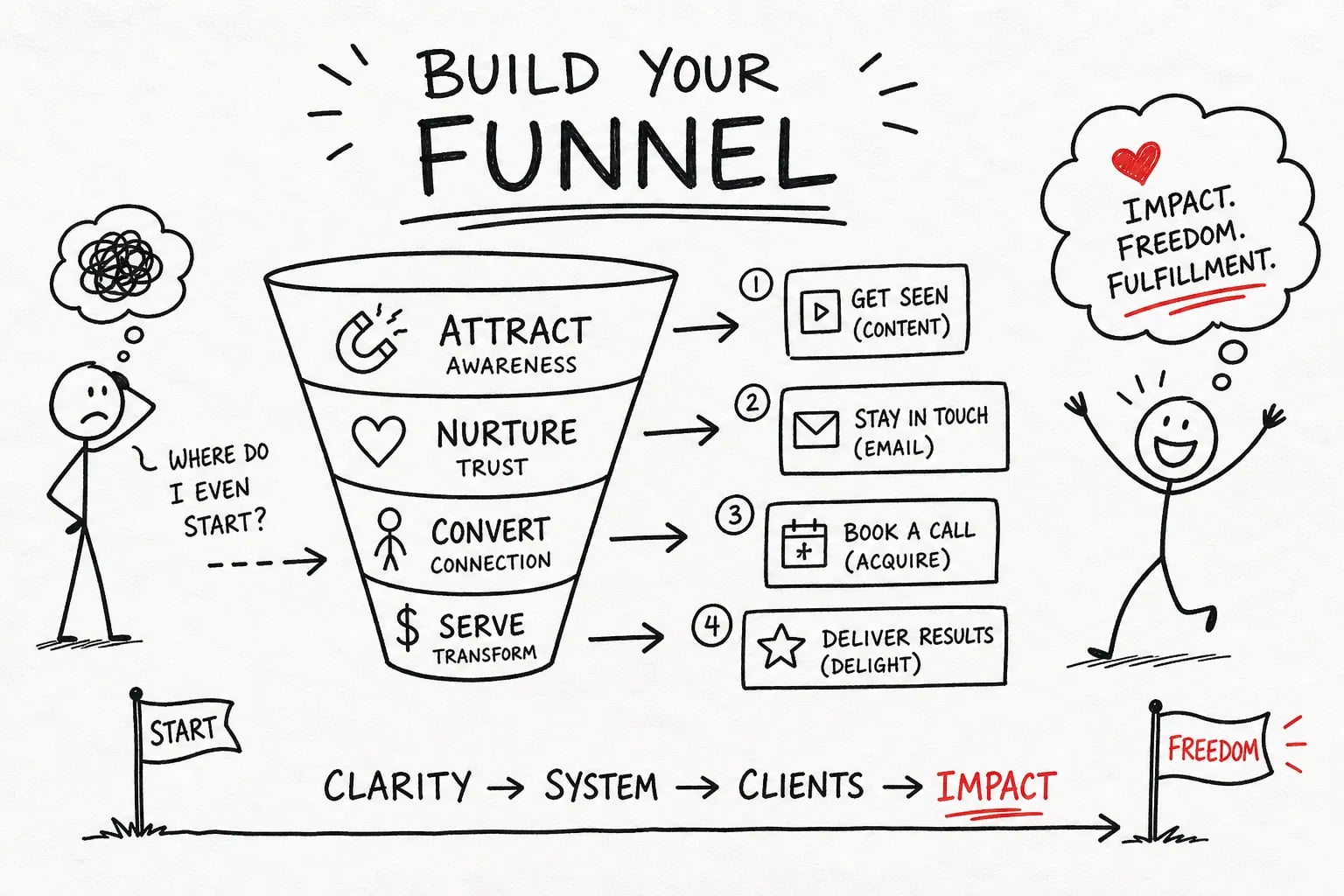
If you’re wondering how to build a funnel for your coaching business, you’re not alone, and the confusion is understandable. After hours of YouTube tutorials and conflicting advice, most coaches still aren’t sure what to build first, in what order, or how all the pieces connect. Many coaches report that building a consistent client-attraction system is harder than the coaching itself.
This article walks through the full process of building a coaching funnel from scratch: strategy, copy, tools, and sequencing. Every layer gets covered so you’re not left guessing. The framework here reflects the same process the team behind Client Acquisition Engine™ used when designing the AI system inside Funnel In A Box, and there’s a faster path waiting at the end for those who want it.
By the time you finish reading, you’ll know exactly what assets to create, in what order, and how to connect them into one automated system that works while you coach.
How to Build a Funnel: What a Coaching Funnel Actually Looks Like
A coaching funnel is not a single landing page or a single email. It’s a structured journey that moves a stranger from “I have a problem” to “I want to work with you specifically”, before they ever get on a discovery call. Understanding that full journey before you touch any tool is what separates coaches who build working funnels from coaches who build a pile of disconnected pages.
The phases every coaching funnel must cover
Every high-performing sales funnel for coaches operates across three phases. The first is the attract phase (top of funnel): this is where strangers first encounter you and decide whether your content speaks to their problem. The second is the nurture and belief-shift phase (middle of funnel): this is where you build enough trust and credibility that the prospect begins seeing you as the right solution for their situation. The third is the conversion phase (bottom of funnel): this is where a warm, pre-sold prospect takes action and books a call.
Many coaches skip the middle phase entirely. They run ads or post content, then point people straight to a booking page, and wonder why no one schedules. Cold prospects need to be warmed up before they’ll commit, jumping straight from attract to conversion leaves that gap wide open.
The five assets that make up a complete coaching funnel
A set of consistently high-performing coaching funnels shares the same five core assets: attract content (ads, posts, Reels), a lead magnet with a dedicated landing page, a nurture email sequence, a video sales letter (VSL) or sales page, and a booking page. These are your building blocks. Everything else is optional until these five are solid and working together as one system.
How to Attract the Right People Before They’ve Heard of You
The attract phase is where most coaches make their first mistake. They create content without a destination. Great content on Instagram or Facebook needs to send traffic somewhere that captures the lead. That destination starts with a lead magnet, and the lead magnet needs to be specific enough to actually earn the opt-in.
Choosing a lead magnet that works for a high-ticket coaching offer
The highest-converting lead magnets for coaches are specific and outcome-focused. A short quiz, a free audit, a one-page framework, or a short video training that teases the transformation consistently outperforms generic PDF ebooks. Interactive or decision-based formats like quizzes can hit opt-in rates of 30, 50% when matched to the right audience, based on observed benchmarks from Meta campaigns in the coaching space. A tightly written checklist or cheatsheet typically lands in the 24, 42% range. Generic ebooks often sit closer to 3, 8%.
The difference comes down to the specificity of the promise, not design. A lead magnet that says “The 3-question audit that reveals why your coaching business isn’t scaling” will consistently outperform one that says “Free guide to growing your coaching business.”
Where coaches should drive traffic and what conversion rates to expect
For most B2C coaches, Instagram and Facebook are the right starting point. LinkedIn works better for B2B consultants targeting corporate buyers. The goal isn’t to be on every platform, it’s to build one reliable traffic source that feeds one opt-in consistently. Running Meta ads to a lead magnet landing page is the most direct path to predictable leads. Discovery call campaigns have been observed to run roughly $28, 53 per lead depending on offer specificity and audience targeting, though your numbers will vary.
A landing page with a specific, outcome-driven offer converts at 25, 40%. A weak, generic page converts at 3, 8%. Before you spend money on ads, fix the promise.
Writing Copy That Moves Prospects From Curious to Convinced
Most coaching copy fails for one reason: it describes the offer instead of shifting the beliefs that are blocking the prospect from saying yes. Prospects don’t buy coaching because they understand what coaching is. They buy because they believe this specific coach can solve their exact problem, and that now is the right time to act. Your copy needs to create that belief, not just describe your program.
The belief gaps a coaching funnel must close
Every piece of copy in your funnel should address one of three belief gaps. First: does the prospect believe the problem is real and urgent enough to act on now? Second: do they believe the solution, coaching, specifically, actually works? Third: do they believe they can get that result with you? Your nurture emails, your VSL, and your booking page each handle one of these questions. If your marketing funnel isn’t converting, one of these gaps is still open.
How to structure a VSL that pre-sells the discovery call
The VSL is one of the most important conversion assets in a coaching funnel. It’s designed to address all three belief gaps before the sales call ever happens. A strong coaching VSL follows this sequence: hook the problem by calling out exactly who the video is for, amplify the cost of staying stuck, introduce your unique mechanism (why your approach works differently), show proof through client results or your own story, present the offer clearly, address the most common objections, and close with one direct instruction to book a call.
Don’t skip the mechanism step. That’s where most coaching VSLs fall flat. Prospects can find a dozen coaches who promise the same outcome. The mechanism is what makes your method feel different and credible.
What a nurture email sequence looks like after the opt-in
At minimum, you need a 5, 7 email sequence running after the opt-in. Here’s how to structure it:
- Email 1, Delivers the lead magnet immediately and sets expectations for what’s coming next.
- Email 2, Shares your origin story and why you do this work.
- Email 3, Teaches one fast win tied to their core problem.
- Email 4, Reframes the deeper cause of the problem, showing why common advice fails.
- Email 5, Uses a client story or case study to build proof.
- Email 6, Introduces your coaching offer and addresses common objections.
- Email 7, Makes a direct CTA to book a call.
Space the emails every two days. The arc is value, then story, then education, then proof, then offer. Don’t sell in every email, build trust through the sequence and let the final emails do the asking.
How to Build a Funnel: The Tech Stack You Actually Need
Coaches don’t need 10 different apps to run a funnel. For a discovery-call funnel that doesn’t require upfront payment integration, the minimum viable tech stack covers four areas: a landing page and funnel builder, an email marketing and automation platform, a calendar and booking tool, and tracking pixels for ads and analytics. Once you add payment processing or more complex automations, you’ll also want a connected payment gateway and form integrations in place before sending traffic.
Funnel builder options by budget: free to paid
For coaches on a tight budget, Systeme.io is the strongest free-plan option in 2026. It includes up to 2,000 contacts, 3 funnels, email automation, and a course tool with no monthly fee. GoHighLevel is a solid all-in-one choice if you want CRM, calendar, email, and funnels under one roof, it starts at $97/month. ClickFunnels offers a fast pre-built route for a complete sales funnel stack at a higher price point.
Pick one platform and stay on it. Switching tools mid-launch kills momentum every time. The best funnel builder is the one that fits your workflow and budget, and that you’ll actually stick with.
The technical checklist before sending any traffic
Before you turn on any ads or post your funnel link publicly, work through this list:
- Connect a custom domain with SSL active.
- Confirm your opt-in form is connected to your email platform and triggers the welcome email automatically.
- Have your full email sequence live and tested before traffic starts.
- Install your tracking pixels on every funnel page.
- Complete at least one full test transaction end-to-end, including the confirmation email and calendar invite.
If any of these steps are missing, sending traffic will only surface the gaps in a way that costs you money.
How to Sequence Your Funnel So Every Piece Reinforces the Next
Building the assets is only half the job. The order in which a prospect experiences those assets determines whether the conversion funnel actually works. A cold prospect who lands on a booking page before watching the VSL is much less likely to book. Sequencing is what turns a collection of assets into a working system.
The order a prospect should move through your funnel
Attract content drives traffic to the lead magnet landing page. The opt-in triggers the welcome email and delivers the lead magnet. The nurture sequence runs over 5, 7 days. The VSL gets introduced around day 3, 4, when trust is partially built. The final emails in the sequence point to the booking page. Booked calls go into the CRM or sales pipeline with a pre-call confirmation sequence to reduce no-shows.
The automation triggers that connect everything
Four automation triggers make this system run without manual effort. A form submission fires the welcome email immediately. A tag applied to the new lead triggers the nurture sequence. A VSL page view fires a retargeting pixel so you can re-engage prospects who watched but didn’t book. A booking confirmation fires both the calendar invite and a pre-call reminder sequence.
The KPIs that tell you exactly where the funnel is leaking
Track these numbers from day one. Opt-in rate tells you whether the lead magnet offer is compelling enough. Email open rate and click rate tell you whether the nurture sequence is building engagement. Booking rate from the VSL page tells you whether the conversion asset is doing its job. When one of these is off, you know exactly where to look instead of guessing.
The Faster Path: Skip the Manual Build and Let AI Do It for You
After reading the sections above, you’re probably thinking what most coaches think: this works, but it’s a significant amount of work to build from scratch as a solo operator without a marketing team. You’re right. Building a complete funnel manually is a multi-week project, and that’s assuming you don’t hit decision fatigue halfway through the copy.
What building a funnel manually costs you in time
Writing a VSL script, mapping a nurture sequence, building landing pages, connecting automations, and setting up tracking is a substantial undertaking for a solo coach. Many coaches report it taking four to eight weeks depending on complexity, four to eight weeks of not sending traffic, not booking calls, and not generating revenue from the new funnel. The build cost isn’t just effort; it’s the opportunity cost of every week the system isn’t live.
How Client Acquisition Engine™ generates every funnel asset from one conversation
Client Acquisition Engine™ was built specifically to eliminate the manual build process. Instead of creating each asset one by one, a coach describes their offer and their audience in a single conversation, and the AI generates the complete funnel: attract content, lead magnet, nurture email sequence, VSL script, landing page copy, booking page, and follow-up emails. The whole system, not just individual pieces. (As with any AI-generated output, a review pass is recommended before going live.)
What makes this different from using a generic AI writing tool is that every asset is built around one unified strategy. The ads, emails, and VSL all tell the same story and reinforce each other. The belief-shift framework is embedded throughout the system, so the funnel is structured to move prospects through each stage psychologically, not just push them toward a page and hope they convert.
Who the done-for-you AI route makes the most sense for
Client Acquisition Engine™ works well for coaches in a few different situations. It’s a strong fit for coaches building their first funnel who don’t want to figure out every piece from scratch. It’s also useful for established coaches whose current marketing is inconsistent, unpredictable, or still relying on referrals. And it’s worth considering for consultants launching a new offer who want a professional acquisition system without the overhead of agency retainers, which, depending on scope and market, can run several thousand dollars a month or more.
You have two clear options from here: follow this guide step by step and build the funnel yourself, or use Client Acquisition Engine™ to generate the full funnel in one session and start sending traffic immediately.
Build the System, Then Coach at Your Highest Level
Learning how to build a funnel is straightforward once you see the full picture. The hard part is doing it in the right order, with copy that closes the belief gaps, connected to the right tools, without second-guessing every decision. That’s what this guide is designed to eliminate.
The blueprint comes down to five steps: map your funnel stages, build an attract system with a high-converting lead magnet, write copy that addresses all three belief gaps, set up a lean tech stack, and sequence everything into one automated marketing funnel. Every piece has a job, and every piece feeds the next one.
Follow this guide and build it yourself, or let Client Acquisition Engine™ generate the complete funnel for you in a single session so you can start sending traffic the same day. Visit the Client Acquisition Engine™ website to see how the system works and get your funnel built without the manual grind.
Leave a Reply