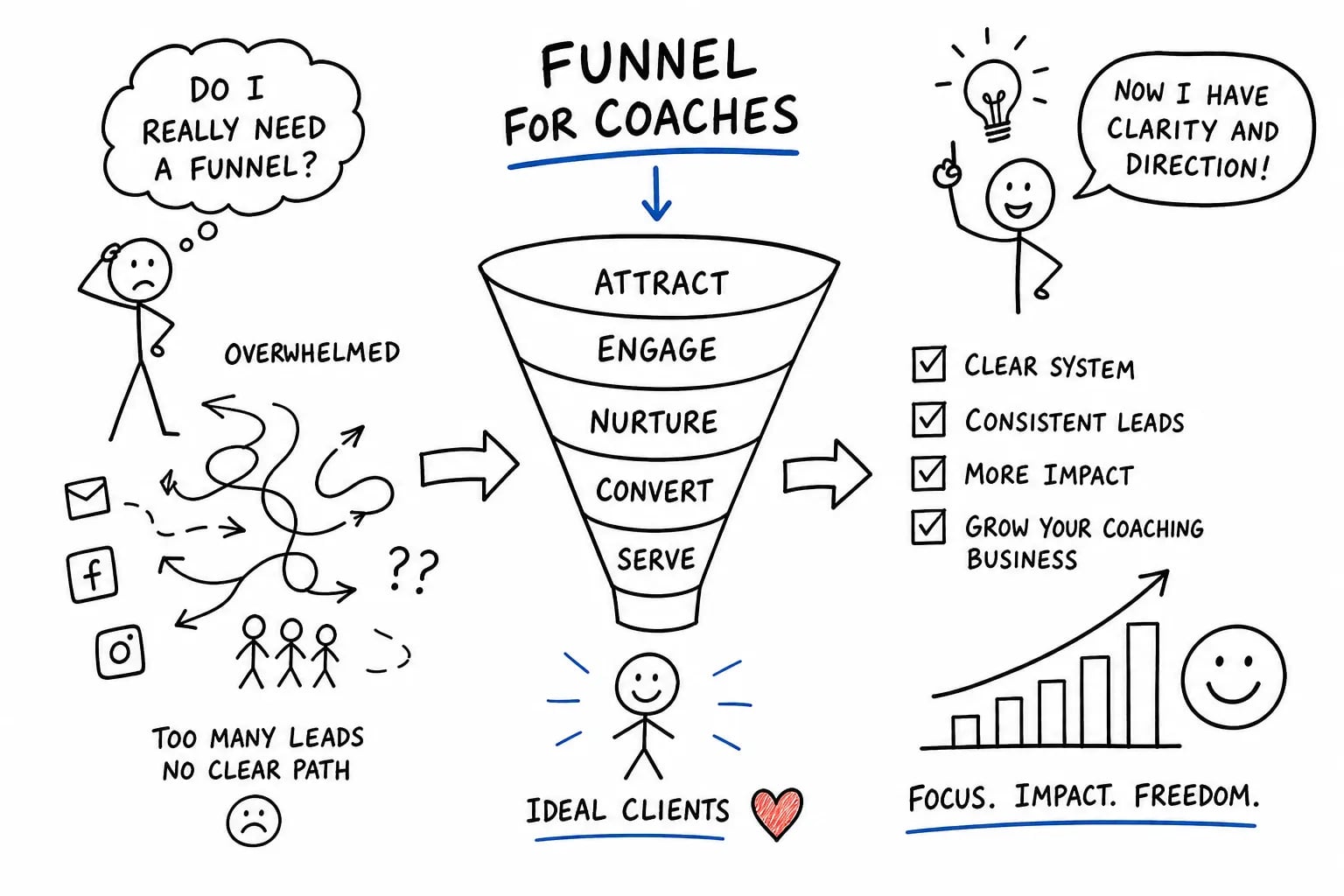
A funnel for coaches is the structured path that moves a complete stranger from “never heard of you” to “ready to invest” without you having to manually chase every lead. When someone tells a coach they “need a funnel,” the reaction is usually somewhere between eye-roll and panic. The word conjures images of complicated tech stacks, confusing flowcharts, and a $5,000 agency retainer that might not even work. That skepticism is understandable. But a properly built coaching funnel isn’t a tech project, it’s a system that works for you around the clock.
The technical barrier has dropped significantly. Tools like Client Acquisition Engine™ now generate an entire funnel for coaches from a single onboarding conversation, which makes “I’m not a tech person” a much weaker excuse than it used to be. What coaches actually need first isn’t a tool recommendation. It’s a clear picture of what a funnel actually is, why it works differently for coaches than for product sellers, and what assets need to be inside it before it can convert. That’s exactly what this article covers.
What a funnel for coaches actually is
A coaching funnel is the deliberate sequence of touchpoints that guides a prospect through awareness, trust, and decision without the coach having to be present at every stage. It’s not a single page, a single email, or a social media profile. It’s the entire sequence working together as one system. Think of it as a three-act structure: someone finds you, starts to trust you, and eventually books a call or buys your offer.
Here’s a concrete example. A coach runs a Facebook ad targeting business owners struggling with burnout. A prospect clicks, lands on a page, and trades their email for a free guide on managing energy. Over the next week, a series of emails shifts their thinking about what’s possible. They watch a short video that explains the coach’s approach and shows client results. At the end of that video, there’s a button to book a discovery call. The prospect books. The coach’s calendar fills up, and none of that required the coach to personally message anyone.
The path a prospect takes before they write you a check
Prospects don’t jump from “who is this?” to “take my money” in a single step. They move through a psychological sequence: awareness, skepticism, curiosity, belief, and finally readiness. A skeptical prospect, for instance, might consume three emails before clicking a single link, they’re watching to see if you’re consistent and credible. Each stage corresponds to a different mental state, and each stage in your funnel needs a different asset to push the prospect forward. Skip a stage and you lose them. Rush a stage and they feel pressured and leave.
Why it’s not just a landing page and an email
Many coaches set up a single opt-in page and a welcome email and call it a funnel. That’s not a funnel, that’s a list-building exercise. A landing page captures attention but doesn’t build trust. A welcome email confirms a download but doesn’t shift a belief. A real client acquisition funnel has distinct layers, and each layer does a specific job the others can’t do alone.
How a coaching funnel differs from a generic marketing funnel
Generic marketing funnels are built around pushing a product to a ready-to-buy audience. Coaching clients aren’t ready to buy. They’re questioning whether their problem is even solvable, whether they’re the right kind of person to be coached, and whether this particular coach is credible enough to trust with a real transformation. That’s a fundamentally different job, and it requires a fundamentally different funnel design.
Generic funnels push; coaching funnels shift beliefs
Before a prospect can say yes to a high-ticket coaching engagement, they need to believe their problem is real and urgent, that a solution actually exists, and that this specific coach can deliver it. Generic funnels skip straight to the offer and assume those beliefs are already in place. A coaching funnel is built around those belief gaps first. The offer only shows up once the groundwork has been laid, which is why belief-shifting content isn’t optional, it’s the engine that makes the rest of the funnel work.
Trust timelines are longer when you’re selling transformation
A prospect buying a $29 product needs seconds of trust. A prospect investing $3,000 or more in coaching needs days or weeks of it. In practice, discovery-call funnels tend to close around 20 to 30 percent of qualified calls when the funnel has done its job, but that close rate collapses when the funnel rushes the relationship. A sales funnel for coaches needs to account for that longer runway by including authority-building content, objection handling, and proof of results before the sales conversation ever happens.
The assets a funnel for coaches must include
A complete coaching funnel operates in three functional layers, and every layer feeds the next. Think of it as a conversion stack where removing any piece weakens everything downstream. Each layer has a specific job, and understanding that job helps you avoid the common mistake of creating assets without knowing what role they’re supposed to play.
The attract layer: getting the right people to notice you
The top of the funnel handles traffic and lead capture. This is where scroll-stopping ads, Reels, hooks, and carousel posts earn attention from cold audiences. It’s also where the lead magnet lives, the free resource that earns an email address and signals intent. The attract layer has exactly one job: get the right person to raise their hand and step inside the funnel. It doesn’t need to explain your entire methodology or close a sale. It just needs to earn a click and an email address from someone who has the problem you solve.
The nurture layer: shifting beliefs before the sales conversation
Once someone is on your list, the nurture layer does the heavy lifting. This is where email sequences, authority content, objection-handling emails, and case-study-style proof earn the trust that a landing page never could. The belief shift happens here. Prospects move from curious to convinced during this phase, which means the discovery call becomes a confirmation rather than a cold pitch. A prospect who has consumed your nurture content already believes you understand their problem, already respects your approach, and is essentially arriving at the call pre-sold.
The conversion layer: VSL, booking page, and follow-up sequence
The bottom of the funnel is where a warmed-up prospect meets the offer. The video sales letter (VSL) compresses trust by walking the prospect through the transformation story one final time and then making the ask. The most effective high-ticket coaching VSLs follow a clear sequence: hook the viewer with a painful question, name the problem and why common approaches fail, show proof, explain the framework, handle objections, and direct the viewer to one action, book the call. The booking page converts that interest into a scheduled call, and the follow-up sequence keeps no-shows and fence-sitters moving toward yes.
Which funnel type fits your coaching offer
The right funnel structure depends on your price point, how much trust your audience needs before buying, and how you prefer to sell. Matching the funnel type to the offer type saves significant time and avoids the frustration of building the right funnel for the wrong situation. If you’re looking for a coaching funnel blueprint to follow, start by identifying which of the three types below fits your offer.
Discovery-call funnels for high-ticket offers
For coaches selling one-on-one programs or premium group coaching at $3,000 and above, the discovery-call funnel is the standard. The flow runs: lead magnet captures the email, nurture sequence builds belief, VSL presents the offer, and booking page closes for the call. Landing page opt-in rates for free offers typically run 8 to 14 percent on cold traffic, and well-structured discovery-call funnels close roughly 20 to 30 percent of qualified calls. The math works when the funnel is properly built and the leads are pre-qualified through the nurture process.
Webinar and challenge funnels for group programs
Coaches selling mid-ticket group programs or cohort offers often need more education before the sale. A webinar funnel for coaches teaches first and pitches second, which is why it performs well for programs that need to demonstrate a methodology rather than just promise a result. Challenge funnels work for coaches who want to build an engaged community before an enrollment period, using participation and momentum as the trust-building mechanism. Both require more complexity than a simple lead-generation funnel for coaches, but they deliver warmer, more committed buyers to the offer.
Why most coaches stall during the build phase
The real problem isn’t that coaches don’t understand what a funnel is. The problem is that building one from scratch requires juggling too many disconnected tools, a page builder here, an email platform there, a calendar tool that doesn’t talk to either, and copy that sounds completely different on every page because nothing was created around a single strategy. That fragmentation is where momentum dies.
The disconnected-tool trap
Picture a coach using one platform for landing pages, another for email, a third for booking, and a free design tool for the lead magnet. Each piece was created separately at different times by a slightly different version of the coach’s thinking. The messaging is inconsistent across assets, the tech integrations break when platforms update, and the whole thing takes six months to launch. By then, the original energy behind the offer is gone, and the funnel reflects five different strategies instead of one.
What happens when each asset tells a different story
When the ad promises one outcome, the landing page speaks to a slightly different audience, and the email sequence talks about something else entirely, prospects feel confused and drop off. A funnel for coaches converts when every asset, from the first ad to the final booking confirmation, tells the same story and moves the prospect through the same belief journey. Inconsistency at any stage breaks the trust that every previous stage worked to build.
Getting a complete coaching funnel without the technical setup
Understanding the structure of a funnel and actually building one are two very different challenges. For coaches who want to stop diagnosing the problem and start running a real acquisition system, Client Acquisition Engine™ (Funnel In A Box) was built specifically for this situation.
What Client Acquisition Engine™ builds from one conversation
A coach describes their offer and ideal audience in a single onboarding conversation, and the AI generates the complete funnel: Facebook and Instagram ads, Reels hooks, email nurture sequences built on the belief-shift framework, a VSL script, landing page, booking page, follow-up emails, and closing scripts. Every asset is built around one unified strategy, which eliminates the disconnected-tool problem by design. There’s no agency to hire, no platforms to stitch together, and no guessing what to write for each piece. As a funnel builder for coaches, it removes the technical barrier that stops most coaching businesses from launching at all.
The difference between patching tools together and having a unified system
The traditional DIY approach typically involves months of setup, inconsistent messaging across assets, and constant troubleshooting when integrations break. A done-for-you engine produces something different: a complete, strategically aligned funnel where every asset reinforces the same belief-shift journey from cold traffic to booked call. Client Acquisition Engine™ also includes a built-in CRM, calendar, and analytics dashboard, so coaches track opt-in rates, booking rates, and show-up rates from one place, no separate reporting tools bolted on as an afterthought.
The answer to the original question
Do coaches really need a funnel? Yes, but not the kind most people imagine when they hear the word. A funnel for coaches is the structured, belief-shifting journey that turns cold traffic into ready-to-buy clients before a sales conversation ever starts. Without it, every new client depends on timing, luck, or a referral from someone who already trusts you. With it, you have a repeatable system that works whether you’re coaching or taking a week off.
Getting started doesn’t require a technical background, a marketing degree, or a big agency budget. Client Acquisition Engine™ hands coaches a complete, unified funnel from day one. The only real question is whether you’re ready to stop posting and hoping, and start running a system that actually moves people from first impression to booked call on purpose. If you are, one conversation is all it takes, the AI handles the rest.
Leave a Reply