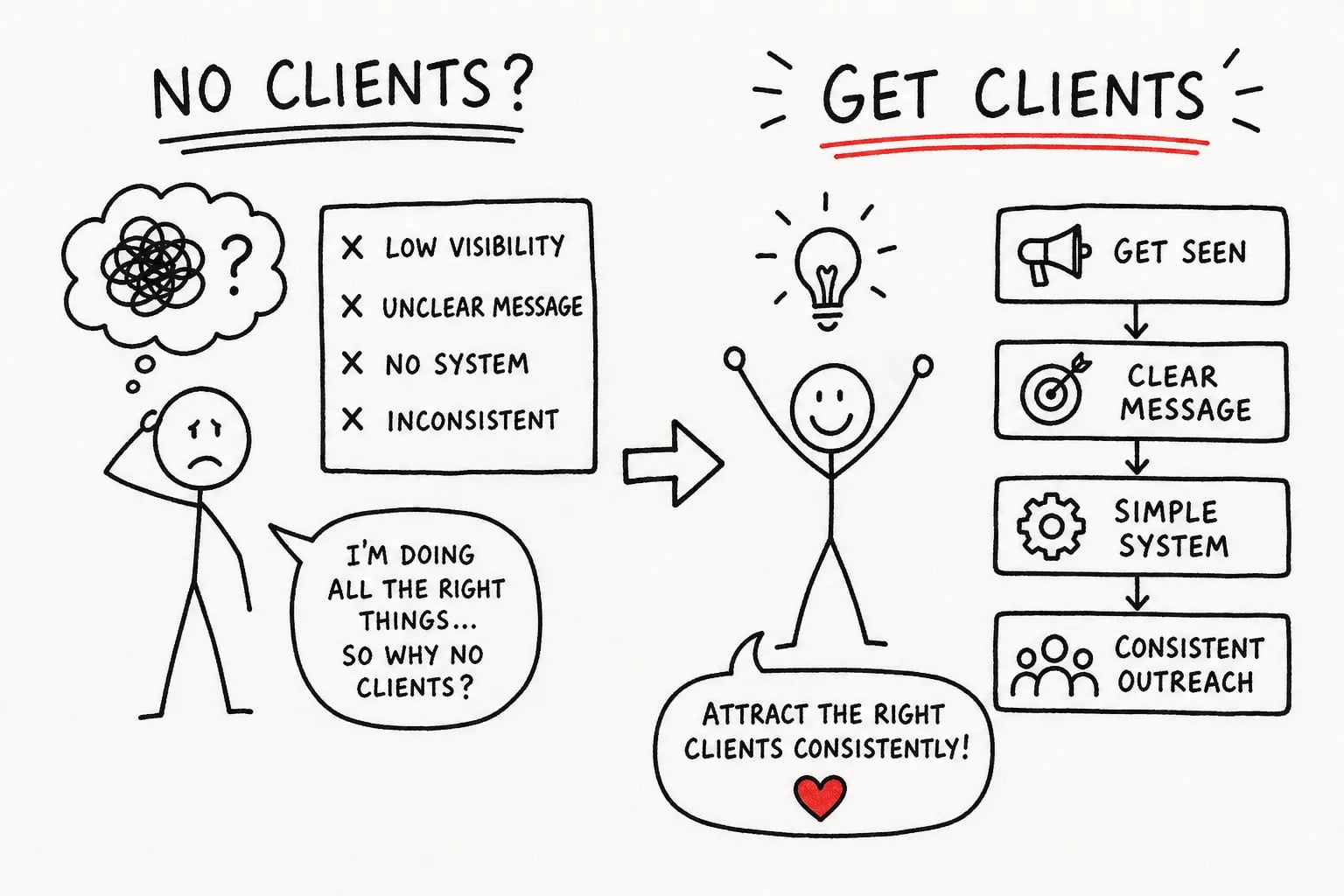
If you’ve ever asked yourself, “Why am I not getting coaching clients?”, you’re not alone, and you’re not failing. You’re showing up. You’re posting content, maybe running ads, sending DMs, and still your calendar sits empty. That gap between effort and results is one of the most demoralizing experiences a coach can face, and it rarely comes from lack of hustle. It comes from a broken acquisition system that nobody taught you how to build.
Most coaches who can’t land paying clients spend weeks searching for the one thing they’re doing wrong. The honest answer is harder to hear: it’s almost never just one thing. Low bookings are almost always the result of multiple compounding problems that reinforce each other at every stage of the client journey.
This article walks through six of the most common pipeline killers, in the order they compound each other. By the end, you won’t just know what’s wrong, you’ll know exactly where to start fixing it.
Why Am I Not Getting Coaching Clients? Start With Your Pipeline
The client acquisition process is a chain, not a single action. Visibility brings people to you. Messaging makes them feel understood. Trust and proof move them closer. The offer gives them something clear to say yes to. And the conversion system turns interest into a booked call. A break anywhere in that chain stalls everything downstream, even if the other pieces are solid.
Think of it like a bucket with holes. Plugging one slows the leak but doesn’t fill the bucket. Coaches who fix their Instagram bio but ignore their offer structure, or who write a great VSL but have no qualifying application, still struggle to see results. The system only works when the chain holds end to end.
A healthy pipeline looks like this: a steady flow of qualified leads, a predictable volume of discovery calls each week, and a closing rate that improves over time because the funnel pre-qualifies prospects before they ever speak to you. Industry benchmarks show warm referral channels typically convert at 15 to 30 percent, while cold Meta ad traffic tends to convert around 1 to 2 percent for coaching offers. That gap exists because trust is built, or not built, long before a prospect clicks your booking link.
Your Offer Isn’t Clear Enough to Attract Paying Clients
A coaching offer and a client-ready offer are two very different things. Most coaches describe what they do: “I help you unlock your potential” or “I guide you to your best self.” Those phrases say nothing a prospect can act on. A client-ready offer tells someone the outcome they’ll get, the timeframe to expect it, and who it’s specifically designed for.
Compare “transformational coaching for growth-minded professionals” to “a 12-week program for first-year consultants who want to land their first $10K client.” The second speaks directly to someone. The first speaks to no one in particular. Life coaching packages typically range from $900 to $3,500 and business coaching from $3,000 to $10,000 or more, but pricing only holds when the promised outcome is that specific and that explicit.
When your offer is vague, every downstream asset suffers. Your ads don’t convert because there’s nothing compelling to click through to. Your emails get ignored because there’s no clear promise. Your discovery calls start with “so, tell me what you do,” which means you’re starting from zero instead of closing a pre-sold prospect. Clarifying your offer is the single highest-leverage fix in this entire list, because specificity flows into every piece of content that follows.
Your Messaging Skips the Problem Your Prospect Is Actually Feeling
Coaches tend to write in the language of the solution: mindset, clarity, transformation, alignment. Prospects don’t search for those things. They search for relief from something specific, stalled revenue, feeling invisible online, working 60-hour weeks without results. They want someone who understands the exact problem they’re living, not someone who promises a vague version of better.
Messaging data reinforces this. Problem-focused subject lines can lift email open rates by double digits, and curiosity-driven lines can push even higher. Personalized outreach that uses someone’s first name alongside specific context consistently outperforms generic messages across every coaching lead generation channel. These aren’t small margins; they compound across every touchpoint in your funnel.
The positioning shift is practical. “I help entrepreneurs build confidence” becomes “I help first-year coaches land their first three clients without cold DMs or paid ads.” One is about you. The other is about them. Here’s the fastest way to fix your messaging: write down the three sentences your ideal client says to themselves at 2am before they fall asleep. That internal monologue is your copy. Use their words, not yours.
You’re Posting Content With No Belief-Shift Journey Behind It
Content volume and content strategy are not the same thing. Posting motivational quotes, tips, and behind-the-scenes moments builds familiarity, but familiarity alone doesn’t convert. Without a structured sequence behind your posts, followers scroll, nod, and forget you by the next morning. The missing ingredient is a belief-shift journey: a deliberate progression of content that moves someone from “I’ve heard of you” to “I trust you understand my problem and I’m ready to talk.”
A structured belief-shift sequence moves through three phases. First, attract content that speaks directly to the pain your ideal client feels and stops them mid-scroll. Second, educate content that repositions how they see the problem and builds your authority around the solution. Third, convert content that stacks social proof and issues a direct, specific call to action bridging to the next step. Each phase does different psychological work, and all three need to be in place before a cold follower becomes a warm prospect.
That architecture is something you can build manually, or you can shortcut it. Client Acquisition Engine™ (Funnel In A Box) is built around exactly this framework. Coaches describe their offer in a single conversation, and the system generates a full content sequence: Reels hooks, carousel posts, email nurture, and objection-handling content, all structured to move prospects through the belief-shift stages in order. The conversion isn’t accidental; it’s by design.
There’s No System Converting Your Content Into Discovery Calls
Attention without a clear next step is just traffic with nowhere to go. A working acquisition system needs, at minimum, three assets working together: a video sales letter that qualifies and pre-sells, a landing page built around your specific offer, and a booking page with a short application that filters for fit. Many coaches have none of these, or they have disconnected versions that tell different stories at each step.
Social proof placement matters more than most coaches realize. Conversion research consistently shows that positioning proof next to your main claim, near pricing, and directly beside the CTA produces the strongest lift. Most coaching websites do the opposite: credentials at the top, testimonials buried at the bottom, where a large share of visitors never scroll. The layout itself is leaking bookings.
The bigger problem usually isn’t a missing asset, it’s assets that don’t tell a consistent story. An ad promises one outcome, the landing page frames it differently, and the discovery call starts from scratch. Each touchpoint resets the trust instead of building on it. The Client Acquisition Engine™ system addresses this by aligning the full conversion stack, ads, VSL, landing page, booking page, and follow-up email sequence, around a single core message. Every asset reinforces the same story, so the belief-shift compounds at each touchpoint rather than restarting.
Social Proof and Your Discovery Calls Are Leaking Qualified Leads
Not all social proof works equally. Video testimonials that show a specific transformation tend to outperform generic written reviews, because they feel real and give prospects context they can map onto their own situation. Case studies are especially powerful for high-ticket offers because they walk through the before, the process, and the measurable outcome. In terms of conversion impact, the rough ranking runs: video testimonials showing transformation, before-and-after case studies with named clients, photo-backed written testimonials with specific results, and then counts or badges as supporting proof only. Logos and follower numbers add credibility but rarely close the deal on their own.
Why No-Shows and Low Close Rates Are Different Problems
On the discovery call itself, benchmarks for new coaches typically put discovery-to-paid conversion rates between 10 and 20 percent. Tightening your qualification process, messaging alignment, and call structure can push that toward 25 to 35 percent. Two changes move the needle more than anything else: use an application instead of an open booking link, and ask 11 to 14 substantive questions during the call rather than pitching early. Research from sales analytics platforms like Gong suggests the most effective discovery calls follow roughly a 43 percent talk to 57 percent listen ratio, meaning your job is diagnosis, not presentation.
Here’s a simple diagnostic: if your call bookings are low, the problem lives upstream in your funnel. If your show rate or close rate is low, the problem is in your qualification process and call structure. Both are fixable, but they require different interventions, and mixing them up is a common time-waster.
The Fix Isn’t Another Piece of Content Advice
If you’re still asking why you’re not getting coaching clients, the answer almost always lives in the gap between scattered effort and a structured system. Every piece of your acquisition chain depends on the one before it. A clear offer makes your messaging sharper. Sharp messaging makes your content more effective. Effective content feeds a funnel that converts. A converting funnel delivers pre-qualified prospects to a discovery call where your closing rate actually means something.
Go back through the six sections above and identify the one where you recognized yourself most clearly. That’s your starting point. If your honest answer is “all of them,” that’s not a sign you’re failing, it’s a sign you need a system, not another tactic bolted onto a broken foundation.
That’s exactly what Client Acquisition Engine™ was built to solve. One conversation about your offer and your audience, and the system builds your entire acquisition engine. The output includes ads, belief-shift content, a VSL, landing page, booking page, email sequences, and follow-up scripts, all telling one consistent story. If you’re ready to stop patching holes one at a time and start running a system that actually works, reach out to our team and see what a complete funnel looks like for your specific coaching offer.
Leave a Reply