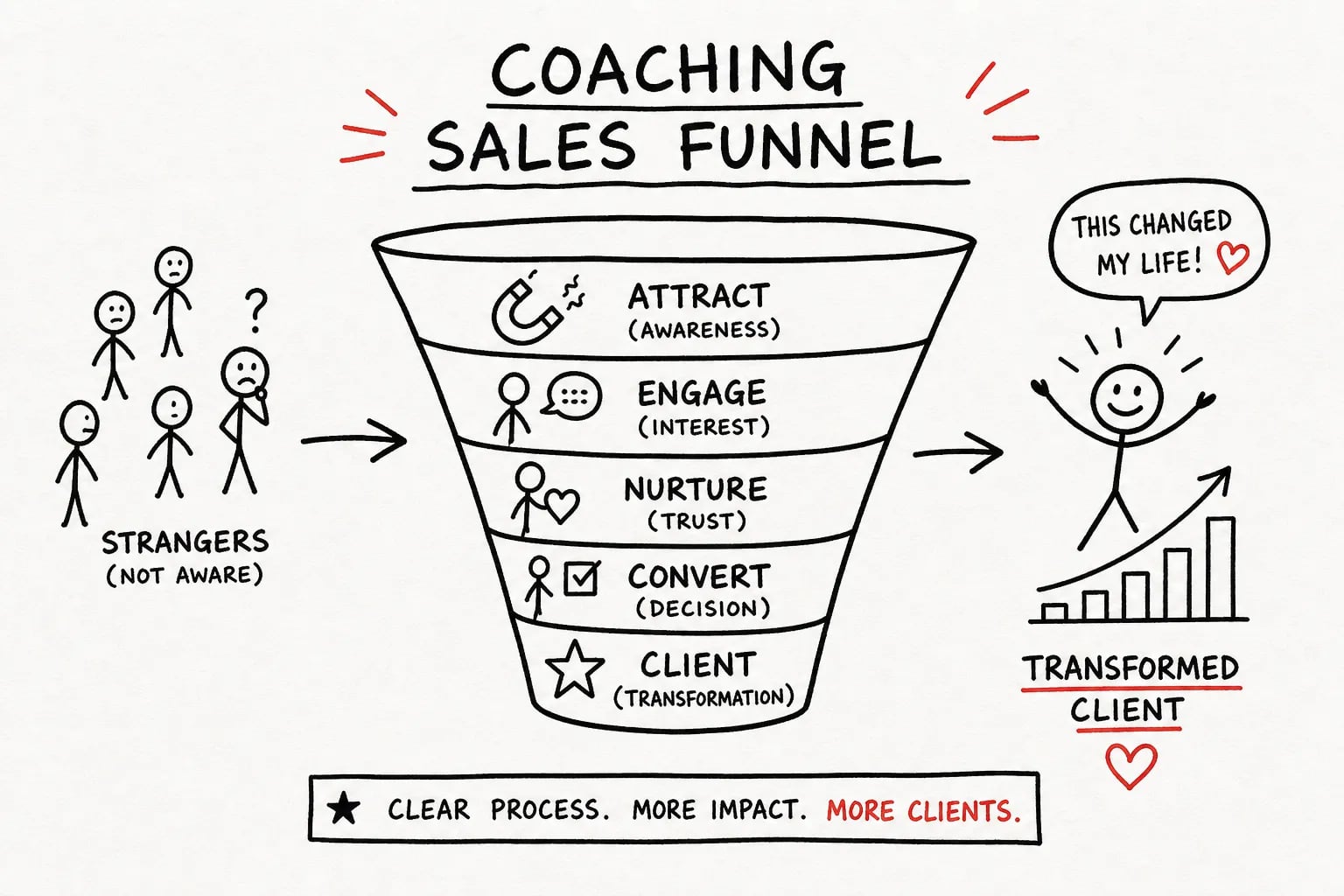
Many coaches don’t have a client problem. They have a system problem. The offer is solid, the transformation is real, and the coach genuinely knows how to help, but strangers keep landing on a booking page and disappearing without ever hitting “schedule.” That’s not a messaging failure. That’s a structural gap. A coaching sales funnel isn’t just a landing page or a calendar link you post in your bio. It’s a connected sequence of assets that moves someone from cold traffic to ready-to-buy, before they ever speak to you. The problem is that most coaches build one or two pieces, call it a funnel, and wonder why the calls don’t come.
This guide maps every stage of a high-converting coaching sales funnel, from the first ad impression to a booked discovery call. It names the exact assets each stage requires, shows you where most coaches quietly lose the sale, and gives you the benchmarks to know whether what you have is actually working. Coaches who use a system like Client Acquisition Engine™ (Funnel In A Box) skip the assembly problem entirely because every asset in this guide gets built from a single conversation. But if you’re building manually, this is the full map.
Why Most Coaching Sales Funnels Break Before a Single Call Gets Booked
The stages coaches skip without realizing it
A common pattern among coaches looks like this: post on Instagram, include a link in bio, link goes to a booking page. That’s not a funnel. That’s a leap of faith across a canyon. What’s missing between those two points is a capture mechanism, a belief-shift sequence, a video sales letter or pre-sell, and a qualification step. Traffic arrives cold, hits a booking page with no context, and bounces. The coach assumes the content isn’t good enough and posts more. The content isn’t the problem. The structure is.
This is a structural gap, not a work ethic issue. Coaches who invest in content creation without a system to capture and convert that attention are essentially filling a bucket with a hole in it. The leads exist. They just have nowhere to go that makes them want to stay.
What cold traffic actually needs before it converts
Cold traffic doesn’t know who you are. More importantly, they’re not yet convinced they have the specific problem you solve. Before a prospect will hand over their email address, watch a video, or book a call, they typically move through several psychological stages: awareness, curiosity, belief shift, desire, and intent. Each stage requires a specific type of content to move them forward. Skip a stage and the prospect stalls.
The most damaging skip is the belief-shift middle of the funnel. This is where a prospect stops seeing their problem as inevitable and starts seeing your method as the solution. Without that shift, you get leads who show up to calls skeptical, unprepared, and easy to lose. A pre-call sequence that includes nurture emails, objection-handling content, and a VSL is what creates a prospect who arrives already half-sold. Most coaches go straight from “opt-in” to “book a call” and skip this entire layer.
Choosing the Right Coaching Sales Funnel Type for Your Offer
The four main funnel models and what each one does
The freebie-to-call funnel is the simplest model: traffic lands on an opt-in page, the prospect downloads a lead magnet, enters a nurture sequence, and eventually books a call. It’s best suited for coaches building their list, serving warmer audiences, or selling offers typically under $1,000 to $2,000 depending on audience warmth. The path is short and the friction is low, which makes it a smart starting point.
The webinar funnel adds an education layer between opt-in and offer. A prospect registers for a live or automated training, watches you teach and demonstrate authority, and receives a pitch at the end. This model shines for mid-to-high-ticket offers in the $1,000 to $5,000+ range because the extended format handles objections in real time. Webinar funnels convert roughly 5 to 15 percent of attendees to buyers, which makes the model worth the extra setup when the ticket justifies it.
The challenge funnel runs a prospect through a short, immersive experience over three to five days. It builds trust through participation and creates momentum before the offer is presented. It works especially well for community-driven programs and launch cycles where visible quick wins drive purchase decisions.
The application funnel is the highest-friction and highest-quality model: a prospect reads a landing page or watches a VSL, applies to work with you, and books a call only after qualifying. This enrollment funnel is built for premium, limited-capacity coaching where call quality matters far more than call volume.
A simple rule for matching funnel type to price point
Use a freebie-to-call funnel when you’re building your audience or selling a lower-ticket offer and need a simple, fast path to booked calls. Use a webinar funnel when your offer requires education and objection handling before a prospect will commit. Use an application funnel when your program is selective, premium-priced, or limited in capacity and you want only qualified, motivated prospects on your calendar. Use a challenge funnel when your audience responds to participation, community, and a visible transformation before the sale.
A practical benchmark to anchor the decision: if your offer is under $1,000, the friction of an application funnel will kill your conversion rate. If your offer is above $5,000, sending cold traffic directly to a booking page without pre-qualification will fill your calendar with the wrong people.
Every Asset Your Coaching Funnel Needs, Stage by Stage
Top-of-funnel assets for a coaching sales funnel
The top of the funnel has one job: pull the right stranger in and capture their contact information. That requires attract content, ads, Reels, hooks, and authority posts designed to stop the scroll and create curiosity. It also requires a landing page with a specific lead magnet offer and a thank-you page that delivers on the promise and sets the next step. Strong opt-in pages convert 15 to 40 percent of visitors depending on traffic temperature. Many underperforming pages fall below 10 percent conversion; the most common causes are a generic headline and no specific promised outcome.
The opt-in page formula is straightforward: lead with a specific problem-aware headline, name the clear outcome the lead magnet delivers, and include a single call to action. Those three elements are what the page needs. Every additional element competes for attention and pulls the visitor away from the one decision you need them to make. When coaches use proven coaching funnel templates that follow this structure, conversion rates consistently outperform pages built from scratch without a framework.
Middle of funnel: belief-shift emails, VSL, and nurture sequence
This is the layer most coaches skip entirely, and it’s the one that determines whether your leads are warm or frozen by the time they see your offer. A nurture sequence is not a newsletter. It’s a structured series of emails designed to shift three specific beliefs: that the prospect has a real and solvable problem, that your method is the right solution, and that they’re capable of getting the result you promise. A well-built indoctrination sequence of three to five emails, used as a guideline for moving engaged leads forward, can shift roughly 15 to 25 percent toward booking a call.
The VSL sits in the middle of this layer and does the heavy lifting. It expands on the method, shows proof, handles the most common objections, and delivers a clear call to action to book. Objection-handling posts and emails reinforce the message across the sequence. Client Acquisition Engine™ (Funnel In A Box) is designed to build this entire middle layer, the email sequence, the VSL script, and the belief-shift content, from one conversation, with a single consistent message running from the first ad to the final booking page. For coaches building manually, this layer takes the most time and is most often the gap between a funnel that looks complete and one that actually converts.
Bottom of funnel: booking page, pre-call sequence, and follow-up
The bottom of the funnel is where the conversion happens, and it requires more than a calendar embed. A strong booking or application page filters for quality, sets expectations, and primes the prospect before the call. The confirmation and reminder email sequence that follows reduces no-shows dramatically. Coaches who add a pre-call sequence to their sales funnel for coaches typically see no-show rates drop from 40 percent to under 10 percent within 30 days of implementation. That single change often doubles or triples actual completed calls per week without adding a single new lead.
Pre-call indoctrination emails arrive between booking and the call. They reinforce why the call matters, what the prospect should prepare, and what transformation is possible. A prospect who has been through this sequence arrives primed and motivated. Discovery calls with well-primed prospects close at 25 to 40 percent. Cold calls to unprepared leads routinely fall below 15 percent. The difference is the pre-call layer, not the sales skill on the call.
The Core Tech Stack for a Coaching Funnel in 2026
What you actually need and what you can skip early on
A coaching sales funnel requires five functional categories: a landing page builder, an email system and CRM, a VSL or webinar delivery tool, a payment and checkout mechanism, and a calendar and booking system. Every other tool is optional until the funnel is converting consistently. Coaches who stack tools before they have a working funnel spend more time on integrations than on clients.
For budget-conscious coaches starting out, Systeme.io offers a free tier that covers landing pages, email, and basic CRM in one place. GoHighLevel at around $97 per month is a widely used all-in-one option that combines funnels, CRM, email, SMS, and booking in a single platform. Kajabi at $143 and up works well for coaches who also sell courses or digital products alongside their coaching programs. ClickFunnels remains a solid choice for coaches who prioritize conversion-optimized funnel flows for high-ticket offers. Start with the fewest tools that cover all five categories and add complexity only when a working funnel justifies it.
The real cost of stitching multiple tools together
The monthly subscription cost is the visible part of the problem. The hidden cost is the conversion leakage that happens when tools don’t pass data cleanly, messaging shifts tone between platforms, and a prospect experiences a disjointed journey from the first email to the booking page. Every seam between tools is a place where the story breaks and the prospect hesitates. That hesitation compounds across thousands of prospects and shows up as a low booking rate that no amount of optimization inside a single tool can fix.
A unified system produces a more coherent client acquisition funnel. When every asset, from the first ad to the confirmation email, tells the same story with the same voice and the same core message, the prospect feels led rather than redirected. That coherence is what raises conversion rates at every stage, not better copy on a single page.
Conversion Benchmarks and the Fastest Fixes for a Leaky Funnel
What good numbers look like at each stage
Opt-in pages should convert 15 to 40 percent of visitors. If yours is below 10 percent, the headline or the lead magnet offer is the problem. A strong email nurture sequence moves roughly one in five engaged leads to book a call. If your booking rate is lower, the sequence is either too short or not addressing the right objections. Discovery calls should close at 25 to 40 percent. If yours are below 20 percent, the issue is usually lead quality or a lack of pre-call priming, not the sales conversation itself.
The data from coaching funnel case studies confirms what the benchmarks suggest. One coaching sales funnel raised its conversion rate from 1.8 to 5.4 percent and tripled booked calls per week after restructuring its stages. Another reduced no-shows from 40 percent to under 10 percent in 30 days by adding a pre-call sequence, the same no-show improvement described in the bottom-of-funnel section above. These aren’t exceptional outcomes from exceptional coaches. They’re what happens when the full funnel is in place and each stage is doing its job.
The three highest-leverage optimizations coaches overlook
The opt-in page headline is the first fix. Most coaches use vague language like “live your best life” or “scale your business” that signals nothing specific. A high-converting headline names a specific problem a specific person has right now. Rewrite it to target one problem, one person, one outcome.
The nurture sequence length is the second fix. Most coaches send one or two emails after the opt-in and stop. Many prospects require multiple touchpoints before they trust you enough to book a call, a commonly cited guideline puts that number in the range of four to seven contacts. If you’re stopping at two emails, you’re abandoning leads who were two or three days away from being ready. Extend the sequence and add objection-handling content in emails three through five.
The booking page is where many coaches leave the most money on the table. A default calendar embed with no copy, no pre-framing, and no explanation of what the call will cover produces high anxiety, low commitment, and elevated no-show rates. Add a short paragraph above the calendar that explains what happens on the call, who it’s for, and what the prospect should prepare. That single addition reduces no-shows and meaningfully improves the quality of prospects who complete the booking.
A Complete Coaching Sales Funnel Is the Only Funnel That Works
A coaching sales funnel is not a landing page. It’s not a lead magnet. It’s not a calendar link in your bio. It’s a connected sequence of assets that moves a cold stranger through awareness, belief, desire, and intent until they show up to a call already bought into the transformation. Every stage requires specific assets, and every skipped stage is a leak that compounds into a broken pipeline and an unpredictable revenue curve.
Coaches who build this manually face a real time cost. Writing the emails, building the pages, scripting the VSL, connecting the tools, and keeping the message consistent across every asset takes significant time, estimates for a comprehensive, polished funnel range from dozens of hours to several weeks depending on scope and experience. Most coaches spend more time building the funnel than they spend coaching, which is the opposite of the goal. That’s the gap Client Acquisition Engine™ (Funnel In A Box) is designed to close. Describe your offer and your audience in one conversation, and the system works to build every asset in this guide: the ads, the belief-shift emails, the VSL script, the landing page, the booking page, and the pre-call sequence. The full funnel, in one place, telling one consistent story from the first impression to the discovery call.
If you’re ready to stop building in fragments and start running a coaching sales funnel that actually converts, reach out to our team and see how Client Acquisition Engine™ builds your complete client acquisition system from a single conversation.
Leave a Reply